Updated: 24 November 2026 · ZEEDDENT information article, based on the studies cited at the end · 7 min read
Wisdom teeth do not need to be removed automatically. They are extracted when they cause problems: recurrent infections of the surrounding gum, decay, damage to the neighbouring tooth, cysts or pain. For impacted wisdom teeth without symptoms or signs of disease, the 2020 Cochrane review concluded that there is insufficient evidence for routine preventive extraction, and the decision is made together with the patient.1
When extraction is needed, planning on an X-ray or CBCT scan significantly reduces the risks.
At a glance
- Extraction is indicated when a wisdom tooth causes infections, decay, damages the neighbouring tooth or forms cysts.
- For wisdom teeth without symptoms or signs of disease, the decision is made individually, with regular monitoring.1
- Injury to the inferior alveolar nerve is rare: 1.2% temporary and 0.28% permanent, in over 44,000 extractions analysed.2
- A CBCT scan helps assess the relationship with the nerve before surgery.3
- At ZEEDDENT, wisdom tooth extraction costs from 600 RON, depending on its position.
Why do wisdom teeth cause problems?
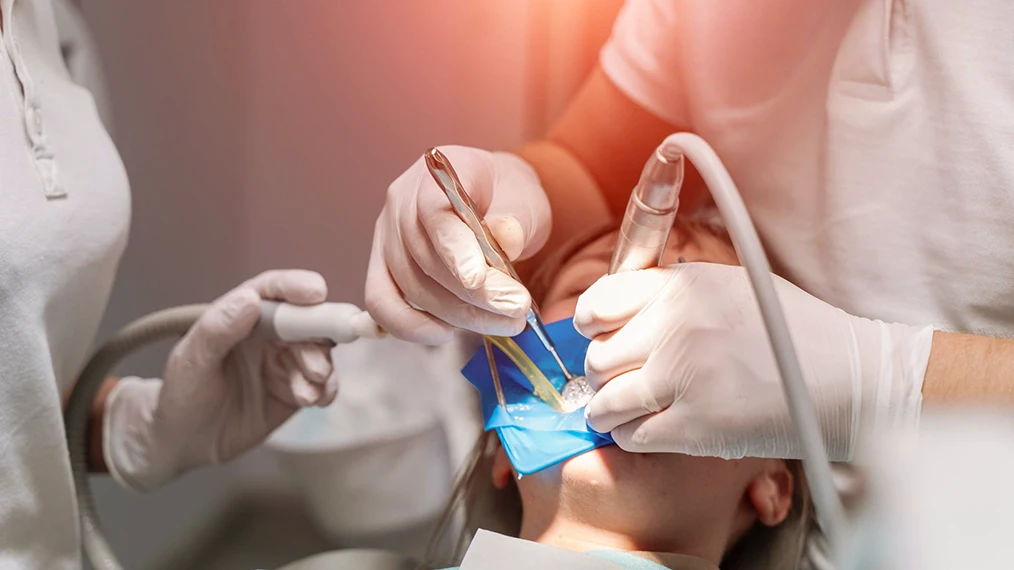
Wisdom teeth, the third molars, erupt last, usually between the ages of 17 and 25. Because there is often not enough space in the arch, they may remain partially or fully impacted in the bone or gum. The most common situations are:
- pericoronitis, inflammation of the gum partly covering the tooth, with pain, swelling and an unpleasant taste;
- decay of the wisdom tooth or the second molar, because the area is hard to clean;
- damage to the bone and gum around the neighbouring molar;
- cysts developing around the crown of the impacted tooth.
Preventive extraction: yes or no?
For a long time, impacted wisdom teeth were removed preventively. The 2020 Cochrane review, the update of the best-known assessment of the evidence on this subject, shows that there is not enough data to routinely recommend extracting wisdom teeth without symptoms or signs of disease. Keeping them may be associated, in the long term, with a higher risk of periodontal problems at the neighbouring molar, but the certainty of the evidence is very low.1
The authors’ practical conclusion: the decision is made together with the patient, and if the tooth is kept, it should be checked regularly.1 That is exactly how we work.
How big are the risks?
The most feared complication is injury to the inferior alveolar nerve, which supplies sensation to the lip and chin. A review of 23 studies, covering over 44,000 lower wisdom tooth extractions, found temporary injury in 1.2% of patients and permanent injury in 0.28%.2
The risk increases when the tooth is deeply impacted, when the roots touch the nerve canal or when the procedure is difficult. For this reason, a CBCT scan is recommended when the X-ray suggests a close relationship with the nerve: it allows a much more precise risk assessment before surgery.3
What recovery is like
- The first 24 hours: pressure with a gauze pad, cold compresses on the cheek, no vigorous rinsing, no smoking, soft and cold food.
- Days 2-3: swelling usually peaks, then gradually subsides.
- The first week: careful hygiene, gentle rinsing as advised by the dentist, removal of stitches if needed.
If the pain increases after the third day, you develop a fever or the swelling does not go down, contact the dentist who performed the extraction.
Dental surgery at ZEEDDENT
At ZEEDDENT, wisdom tooth extractions are planned on the basis of imaging, under local anaesthetic and with minimally invasive techniques. Prices are:
- erupted wisdom tooth: from 600 RON;
- vertically impacted wisdom tooth: from 800 RON;
- obliquely or horizontally impacted wisdom tooth: 1,000 RON;
- cystectomy: 500 RON.
More details are on the Dental Surgery and Rates pages.
FAQ
Frequently asked questions about wisdom teeth
What patients want to know before a wisdom tooth extraction.
No. Those that cause problems or carry a clear risk of doing so are removed. Healthy ones without symptoms can be kept and monitored regularly.
The procedure is done under local anaesthetic, so you should not feel pain. After the extraction, discomfort and swelling are normal for a few days and are controlled with the recommended medication.
Most patients return to normal activities within 2-3 days. Swelling gradually subsides during the first week, while complete bone healing takes longer.
The risk is low: about 1.2% for temporary injury and 0.28% for permanent injury. Assessment on a CBCT scan helps reduce it in high-risk cases.
Extraction of an erupted wisdom tooth starts from 600 RON, a vertically impacted one from 800 RON, and an obliquely or horizontally impacted one costs 1,000 RON.
A wisdom tooth is not a problem in itself. It becomes one when it causes inflammation, decay or damages neighbouring teeth. The decision to extract is made after an examination and imaging.
If you have discomfort around your wisdom teeth, book a consultation for an assessment.
Scientific sources
- Ghaeminia H, Nienhuijs ME, Toedtling V et al.. Surgical removal versus retention for the management of asymptomatic disease-free impacted wisdom teeth. Cochrane Database of Systematic Reviews, 2020. pubmed.ncbi.nlm.nih.gov/32368796/
- Kang F, Sah MK, Fei G. Determining the risk relationship associated with inferior alveolar nerve injury following removal of mandibular third molar teeth: A systematic review. Journal of Stomatology, Oral and Maxillofacial Surgery, 2020. pubmed.ncbi.nlm.nih.gov/31476533/
- Raj K, Arulrasan SG, Murugesan K et al.. Anatomical Risk Factors Associated with Inferior Alveolar Nerve Injury During Third Molar Surgery: A Systematic Review. Journal of Maxillofacial and Oral Surgery, 2026. pubmed.ncbi.nlm.nih.gov/41648694/
Read also
- Periodontitis: signs, stages and modern treatment
- Clear aligners or fixed braces: which suits adults?
This article is for information only and does not replace a consultation. A treatment plan can only be established after a clinical examination and the necessary investigations.